11.12.2025
Market Insights – 11/11/25
Wholesale Prices, Week Ending November 8th, 2025
The Canadian used wholesale market saw a decline of -0.32% in pricing for the week. Car segments prices decreased by –0.26% while the Truck/SUV segments decreased by -0.37%. There was no positive segment this week. The largest declines in the Car segments were seen in Full-Size Car at -1.11% and Sub-Compact Car with -0.51%. The largest declines in the Truck/SUV segments were Full-Size Crossover with -0.91% followed by Full-Size Pickup at -0.73%.
| This Week | Last Week | 2017-2019 Average (Same Week) | |
| Car segments | -0.26% | -0.40% | -0.28% |
| Truck & SUV segments | -0.37% | -0.41% | -0.30% |
| Market | -0.32% | -0.41% | -0.29% |

Car Segments
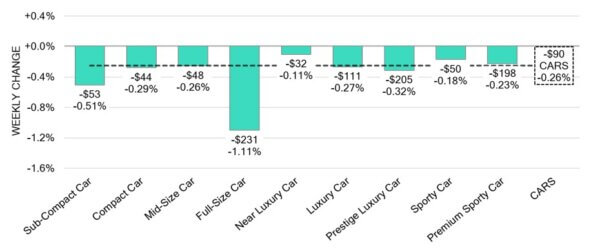
- Last week there was an overall depreciation of -0.25% recorded in car values. All segment groups followed this direction.
- Those with the largest declines were Full-Size Car (-1.11%) followed by Sub-Compact Car (-0.51%), Prestige Luxury Car (-0.32%) and Compact Car (-0.29%).
- The smallest declines were noted in Near Luxury Car (-0.11%) and Sporty Car (-0.18%).
Truck / SUV Segments

- Last week, truck segments declined 0.37% overall, with all 13 segments posting a slip in values.
- The largest depreciations were in Full-Size Crossover/SUV (-0.91%) and Full-Size Pickup (-0.73%). Sub-Compact Crossover, Compact Crossover/SUV and Full-Size Luxury Crossover/SUV all had the same decrease (-0.46%).
- Those with just a slight dip were Mid-Size Luxury Crossover/SUV (-0.07%) and Full-Size Van (-0.16%).
Wholesale
Momentum in the Canadian market’s decline has tapered off slightly, with a softer decline compared to its previous week. With a 0.14% change this week, car segment values now reflect an overall decline of –0.26%. Truck segment values showed a much smaller change of 0.04%, resulting in a total decline of –0.37%. Just over 36% of market segments recorded an average value change exceeding ±$100. Sale rates across monitored auctions ranged from 21% to 65.9% averaging at 23.5%. Sales rates across auction lanes have shown ongoing fluctuations, influenced by economic uncertainty, political factors, and sellers maintaining firm floor prices. Supply has stabilized and returned to regular levels; however, upstream channels continue to hold priority sale access to inventory. Buyer demand for high-quality vehicles at auctions on both sides of the border persists.
Used Retail Prices & Listing Volume
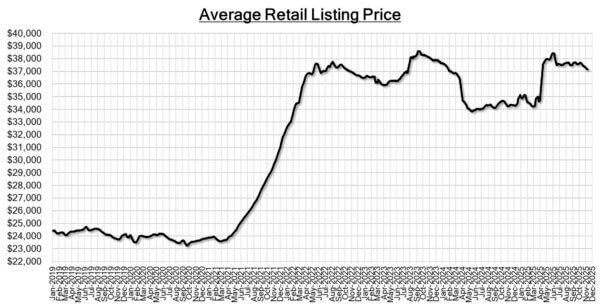
The average listing price for used vehicles is slightly decreasing, as the 14-day moving average was at $37,150. This analysis is based on approximately 212,120 used vehicles listed for sale on Canadian dealer lots.
Market Insights
Economics & Government
- Canada’s employment increased by 66,600 (+0.3%) in October 2025, following a
gain of 60,400 in September, and outperforming market expectations of a 2,500
decline. The unemployment rate in Canada fell to 6.9% in October of 2025 from
the four-year high of 7.1% in the previous month, compared with market
expectations that it would remain unchanged at 7.1%. - The S&P Global Canada Composite PMI rose to 50.3 in October 2025 from 46.3
in September, indicating the first expansion in private-sector activity since
November 2024. - The S&P Global Canada Services PMI climbed to 50.5 in October 2025 from 46.3
in September, rising above the 50.0 threshold for the first time since November
2024, signaling a return to expansion in the services sector. - The yield on the Canadian 10-year government bond increased to 3.13%.
- The Canadian dollar is around $0.713 this Monday morning, up slightly from
$0.711 a week prior.
U.S. Market
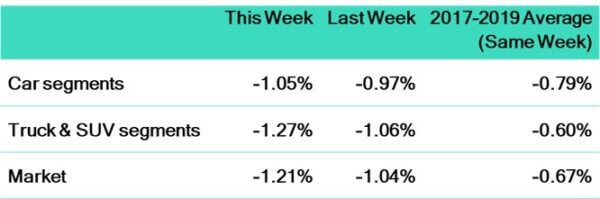
- Depreciation accelerated to -1.21% last week, signaling a market under mounting pressure as the “K-shaped” recovery deepens. Prime-credit consumers continue to support demand for newer and premium vehicles, while mainstream and budget segments face heavier declines amid tighter financing and increased repossessions. The recent expiration of EV tax incentives adds further weight to late-model pricing.
Industry News
- China has granted Nexperia, a microchip manufacturer, to restart exporting of its semiconductors to the auto industry as this supply chain was recently closed off, creating a shortage of vehicles.
- Honda has suffered a significant financial blow larger than that of its impact from tariffs as slowing EV demand for its latest models forcing a one-time charge of $1.5B for write-offs and expenses from lagging electric inventory as well as future EV investments.
- The Federal Budget was released, and while there was spending in many areas with an overall deficit still forecasted, the federal iZEV rebate was not one of those areas mentioned and there was no alternative option hinted at for future discussions.
- More on the Federal Budget highlighted that the luxury tax will continue for vehicles priced over $100,000 dollars, but with a surprise change has eliminated the tax on planes and boats.
- Ford is considering discontinuing its electric version of the F-150 pick-up truck. As it digests the decrease of EV demand across the continent, this could mark the first mass produced electric vehicle to get cancelled.
- Turo has launched long-term rentals to its digital private-ownership rental car platform. Head of Turo Canada, Bassem El-Rahimy says, “Canadian are rethinking what it means to ‘own’ a car” and he went on to share that “rentals lasting 3 or 4 months are Turo’s fastest-growing segment.”
- October new car sales in Canada reached an estimated 159,000, which is 1.8% down versus this time last year. Desrosiers says these numbers, though less than last October are still strong as the Quebec market at that time was purchasing vehicles ahead of EV rebate reductions.