02.25.2026
Market Insights – 2/24/26
Wholesale Prices, Week Ending February 21st,2026
The Canadian used wholesale market saw a decline of -0.60% in pricing for the week. Car segments prices decreased by –0.64% while the Truck/SUV segments decreased by -0.57%. The Full-Size Crossover/SUV segment saw an increase of +0.23%. The largest declines in the Car segments were seen in Full-Size Car at -1.18% and Prestige Luxury Car with -0.98%. The largest declines in the Truck/SUV segments were Full-Size Van with -1.73% followed by Minivan at -1.28%.
| This Week | Last Week | 2017-2019 Average (Same Week) | |
| Car segments | -0.64% | -0.37% | -0.25% |
| Truck & SUV segments | -0.57% | -0.42% | -0.22% |
| Market | -0.60% | -0.40% | -0.23% |

Car Segments
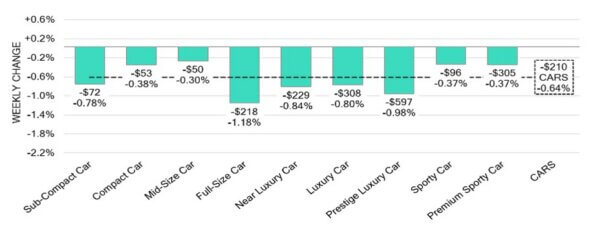
- Last week values softened in the car market, with overall prices declining 0.64 percent.
- The largest drops were seen in Full-Size Car (-1.18%), Prestige Luxury Car (-0.98%), and Near Luxury Car (-0.84%). Luxury Caralso showed a notable downturn (-0.80%).
- The smallest declines occurred in Mid-Size Car (-0.30%), followed by Sporty Car (-0.37%), and Premium Sporty Car (-0.37%).
Truck / SUV Segments
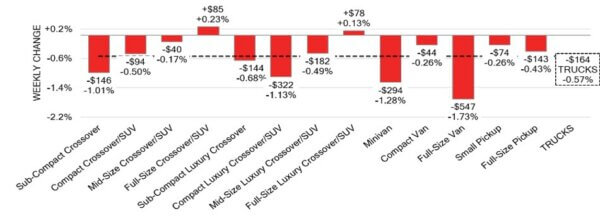
- Last week prices edged lower across the truck market, with overall values declining 0.57 percent.
- The steepest declines were in Full-Size Van (-1.73%), Minivan (-1.28%), and Compact Luxury Crossover/SUV (-1.13%), followed by Sub-Compact Crossover (-1.01%).
- The smallest declines were seen in Mid-Size Crossover/SUV (-0.17%), Compact Van (-0.26%), and Small Pickup (-0.26%), while Full-Size Crossover/SUV (+0.23%) and Full-Size Luxury Crossover/SUV (+0.13%) posted gains.
Wholesale
The Canadian market’s downward trajectory continues, with a decline similar in comparison to its prior week. Car segment values reflected a 0.27% shift resulting in a total decline of –0.64%. Truck segment values presented a 0.15% change, bringing its total decline to –0.57%. Just over 54% of market segments saw average value movements greater than ±$100.Auction sale rates across monitored lanes ranged from 19.4% to 86.5%, resulting in a 51% average. Sales rates across auction lanes continue to fluctuate, driven by political factors, economic uncertainty, and sellers supporting firm floor prices. A slight decrease in supply has been noted; however upstream channels continue to hold priority sale access to inventory. Buyer demand for high-quality vehicles at auctions on both sides of the border persists.
Used Retail Prices & Listing Volume
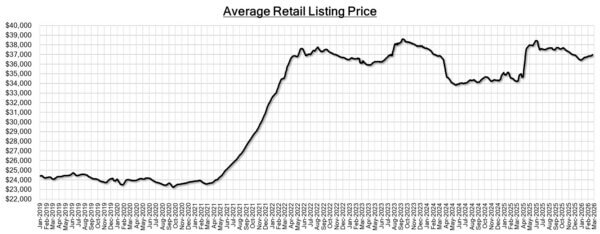
The average listing price for used vehicles is slightly decreasing, as the 14-day moving average was at $37,000. This analysis is based on approximately 198,000 used vehicles listed for sale on Canadian dealer lots.
Market Insights
Economics & Government
- Statistics Canada reported that our Trade Deficit narrowed to $1.31 billion in
December, which was a significant improvement over the adjusted $2.59 billion
reported in November. Exports continue to benefit from the record high prices
for gold. Exports to the US accounted for 67.4% of the total volume in December,
down from 76.2% a year prior. - Retail sales dropped 0.2% in December, led by declines in the sale of
automobiles, automotive parts, furniture, appliances and electronics. - Canada expects to see minimal impact after the US Supreme Court declared that
the tariffs imposed by the Trump Administration under the IEEPA (International
Emergency Economic Powers Act) exceeded the powers granted the Executive. - The yield on the Canadian 10-year government bonds has dropped to 3.02%.
- The Canadian dollar is around $0.730 this Monday morning, a decrease from
$0.735 a week prior.
U.S. Market
- Wholesale values were steady, with Cars nearly flat at -0.02% and Trucks rising +0.18% week over week, led by continued strength in late-model inventory. Full-Size Pickups and newer Full-Size Vans extended multi-week gains, while older units remained softer. Auction conversion registered 62%, reflecting disciplined, retail-aligned buying in a firm and efficient market environment.

Industry News
- December ZEV sales share reached its highest point in 2025 post-rebate removal. Reaching 12.5% market share against a down December YoY, it now represents 9% of total Canadian New car sales. ZEV sales for the year reached 170,052, 36% down versus 2024.
- Matt Girgis, Managing Director of Volvo Cars Canada confirmed that the brand is looking into bringing Chinese-made EVs back to Canada after the tariff deal was struck between the two countries. Volvo is just one of a handful of brands that would now be eligible to bring vehicles back into Canada under the reduced tariff deal that is limited to 49,000 new vehicles.
- Nissan, Mitsubishi and Honda are apparently in more conversation on a partnership that could have them share supply of product, electrified drivetrains and software systems. This comes about a year after the companies failed to agree on a merger of equals.
- Audi has released its next-generation of the performance variant RS 5 in both wagon and sportback forms. It is yet to be confirmed whether North America receives the wagon version, but the new model is powered by a similar 2.9L V6 that has now partnered with a plug-in hybrid powertrain tomake 630hp and travel over 60+ km on electric range alone.
- Toyota’s Cambridge, ON manufacturing facility will employ 7 humanoid robots named ‘Digit’ to work at the plant which assembles the Rav4. Agility Robotics is the business they have partnered with to provide the units and is based out of Oregon.
- A study conducted by CatalystIQ provided a calculation for the U.S. car market of the impact to prices from tariffs based on different countries of origin. With Canada impacted the most at an average of $4,000USD or over 10% the original cost.