05.19.2026
Market Insights – 5/19/26
Wholesale Prices, Week Ending May 16th, 2026
The Canadian used wholesale market saw a decline of -0.32% in pricing for the week. Car segments prices decreased by -0.20% while the Truck/SUV segments decreased by -0.40%. Overall Compact Van segment saw the biggest increase of +1.46%. The largest declines in the Car segments were seen in Luxury Car at -0.52% and Sporty Car with -0.41%. The largest declines in the Truck/SUV segments were Full-Size Van with -1.77% followed by Minivan at -1.29%.
| This Week | Last Week | 2017-2019 Average (Same Week) | |
| Car segments | -0.20% | +0.00% | -0.10% |
| Truck & SUV segments | -0.40% | -0.37% | -0.09% |
| Market | -0.32% | -0.21% | -0.09% |
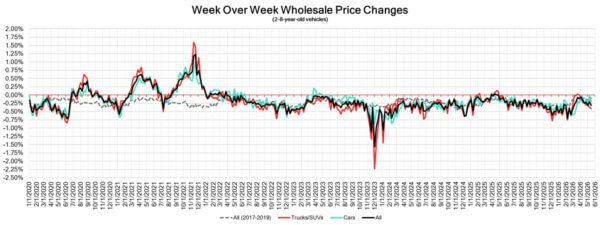
Car Segments
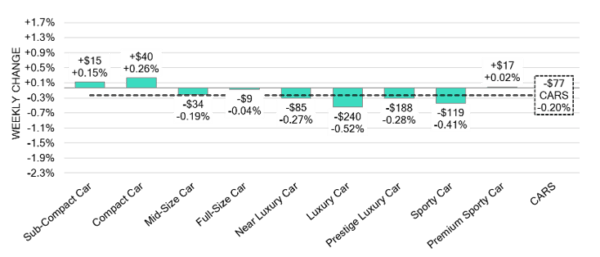
- Last week, Canadian car values declined 0.20% overall as the market remained relatively stable with only modest movement across most segments.
- The largest depreciations were recorded in Luxury Car (-0.52%), Sporty Car (-0.41%), and Prestige Luxury Car (-0.28%).
- Full-Size Car (-0.04%) posted the smallest decline among depreciating segments.
- The strongest-performing segments were Compact Car (+0.26%), Sub-Compact Car (+0.15%), and Premium Sporty Car (+0.02%).
Truck / SUV Segments

- Last week, Canadian truck and SUV values declined 0.40% overall, though performance varied widely across segments with a few categories posting gains.
- The largest depreciations were seen in Full-Size Van (-1.77%), Minivan (-1.29%), and Mid-Size Luxury Crossover/SUV (-0.53%).
- Full-Size Luxury Crossover/SUV (-0.04%) and Compact Luxury Crossover/SUV (-0.05%) recorded the smallest declines.
- The strongest-performing segments were Compact Van (+1.46%) and Small Pickup (+0.10%).
Wholesale
Downward momentum in the Canadian market picked up slightly, with a steeper decrease than last week. Truck segment values experienced a 0.03% shift, resulting in an overall change of –0.40%. Car segment values presented a 0.20% change, resulting in a total decline of –0.20% Approximately 36% of market segments saw average value movements greater than ±$100.Auction sale rates across watched lanes ranged from 25.2% to 48.7%, resulting in a 36% average. Fluctuations in auction performance continues, driven by political conditions and sellers standing firm on floor prices. Auction inventory has returned to normal levels; however upstream channels continue to hold priority sale access to inventory. Buyer demand for high-quality vehicles at auctions on both sides of the border persists.
Used Retail Prices & Listing Volume
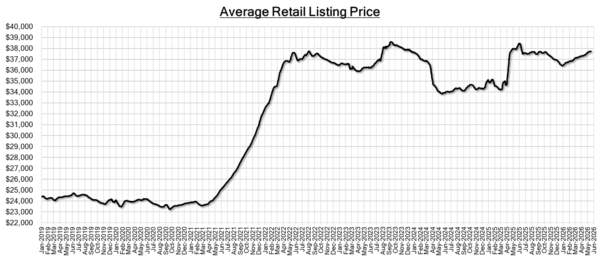
The average listing price for used vehicles is slightly increasing, as the 14-day moving average was at $37,750. This analysis is based on approximately 201,000 used vehicles listed for sale on Canadian dealer lots.
Market Insights
Economics & Government
- March Wholesale sales increased 1.9% as deliveries of machinery, equipment
and supplies rose 6.5% versus February. - Honda Canada confirmed that it has “suspended indefinitely” plans to build new
plants in Canada to produce electric vehicles. Blaming a change in consumer
tastes, the plan was to build plants to assemble vehicles and batteries and
include up to 1,000 new jobs. - The yield on Canadian 10-year government bonds have increased slightly to
3.42%. - The Canadian dollar is around $0.730 this Monday morning, a slight
decrease from $0.734 a week prior.
U.S. Market
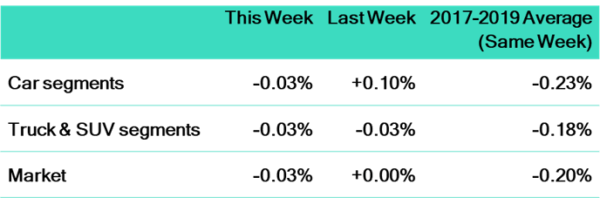
- For the first time in 15 weeks, the overall market reported a week-over-week decline in values. Interestingly, the shift coincided with the point in the calendar when the market has historically begun to experience signs of the spring market winding down. This year, however, seasonal appreciation started much earlier than usual. While 0-to-2-year-old vehicles also declined last week, the 8-to-16-year-old segment continued to strengthen, rising +0.06%. It is worth noting that older model years began posting gains roughly a month later than newer model years.
Industry News
- March sales of zero-emission vehicles amounted to 21,574 units surging to 12.2%, doubling over last year. This is the first whole month where the Electric Vehicle Affordability Plan (EVAP) has been active.
- Honda Motor Company has had a tough time, highlighted by stepping back from its 2040 combustion-free goal and showing off 15 new hybrids after charging off billions in losses on EV development. As well, the company’s investment upwards of $15 billion into another Ontario facility set to produce EVs has been put on hold indefinitely.
- Nissan Motor Company has now shifted into “growth mode”, according to CEO Ivan Espinosa, who said, “we are ahead of plan, and the progress is visible”. This comes after 7 of the last 8 years saw its overall global sales shrink. Nissan is forecasting an expansion in sales of 4.7% to 3.3 million units in its current fiscal year ending March 2027.
- Mazda has announced a delay in the arrival for its planned EVs of 2 years. It was slated to bring in two dedicated EVs to market next year but has now stretched that to 2029. Unlike other manufacturers, Mazda has not incurred sizeable losses and will not have any write-downs from the decision.
- Subaru will suffer a $362 million write-down for delaying its EV developed Japanese-market EV as it steps back plans amidst bringing all-new EVs to the North American market.
- Chinese EV makers have experienced a global sales boost from the Iran war, which has ignited a surge in EV interest and sales for these companies in each of their active markets. With the Canadian market coming online this marks an opportunity to eat up the 49,000 units pegged for this year quite quickly.