
01.07.2026
Canadian Black Book’s 2025 Vehicle Testing Round-up
Every year, our team evaluates over 100 new vehicles, gaining understanding and experience around their latest content, competitiveness, capability, and overall year-over-year changes. Driving different vehicles every week over the course of the past 12 months provides a well-rounded understanding of these changes impacting model competitiveness and evolving valuation relationships with older model-year counterparts. As we are regularly asked, “Why does CBB need to test vehicles?” the answer is simple: to gain an improved understanding of how a new model ages over time given its evolving competitive landscape and how this impacts future valuations. With this message, we hope to communicate the significance represented by revisiting new vehicles continually during their lifecycle, showcasing the responsibility we take in providing the most trusted and accurate valuations possible for our Canadian new car market. The forecasting of Residual Values is paramount to our data analytics received by the industry, but also reflects the early stage transitions we see in value retention within the wholesale market. Whether we see a new carryover model, minor refresh, or full generational change, there are market dynamics that serve each of these shifts significantly.
While it seems like a not-so-metaphorical joyride to drive these vehicles, living with them over short periods of time helps us uncover idiosyncrasies they bring to the table. With strong livability and practicality, or, in some cases lack thereof, these models are expected to support multiple household types across a range of scenarios. From Mainstream Crossovers and Luxury Sedans to the shrinking segment of Economy cars and 2-Seat Sports cars, we assign our experiential thinking to the vehicle type and its purpose.
We’d like to share some of our overall observations and the cumulative trends identified over the last 12 months of vehicle testing. This excludes any staff participation in Residual Value Guidebook events or Ride & Drives attended this year.
Evaluator: Stephen Smith, Manager Residual Values
2025 Highlight: Honda Civic Hatchback Touring Hybrid
Evaluator Notes: “Best all-around vehicle, providing a livable, affordable, stylish, and fun-to-drive experience that does just about everything very well. This is the best Civic I’ve experienced in a long time, maybe going all the way back to the 1996-2000 generation.”
2025 Lowlight: Acura ADX Platinum Elite A-Spec
Evaluator Notes: “Based on a mediocre Subcompact Crossover that receives minimal changes to become a more expensive Luxury Subcompact Crossover, and despite the transplant of the 1.5L turbo engine, the ADX is a very forgettable vehicle in its segment. With many alternate successes between the two brands, it is hard to understand why they missed the mark on this very important vehicle.”
Honorable Mention: Honda Passport TrailSport
Evaluator Notes: “Having driven the previous generation Passport, my expectations were low. However, this is a solid, more competitive vehicle that is noticeably well-thought-out and does a better job of separating itself from its shared-platform Honda Pilot than primary competitors such as the VW Atlas/Atlas Cross Sport and Mazda CX-70/CX-90.”
David Robins, Senior Manager, Head of Canadian Vehicle Valuations
2025 Highlight: Hyundai Ioniq 9 Ultimate Calligraphy
Evaluator Notes: “Best all-around seven-passenger EV. Range, equipment, and effective use of space provide value for money in this growing segment. Hyundai’s flagship three-row electric SUV, designed to be the ultimate family hauler with a focus on interior space, rapid charging, and long-range travel, has hit its mark.”
2025 Lowlight: Mitsubishi RVR GT
Evaluator Notes: “An early-to-market Subcompact Crossover that has been showing its age for a long time. This model has been left out in the market without enough support to remain a considerable option. Cons include an outdated platform leading to weak acceleration and poor road and engine noise isolation (especially with its CVT), with a basic, unrefined interior compared to rivals.”
Honorable Mention: Mercedes GLC 350e (Plug-in Hybrid)
Evaluator Notes: “The GLC 350e offers a compelling blend of Luxury Crossover comfort, strong hybrid performance, and significant electric range, making it a smart choice for those wanting to reduce fuel consumption without going fully electric, allowing it to overcome its premium price and minor cargo compromises.”
Evaluator: Daniel Ross, Senior Manager, Industry Insights & Residual Value Strategy
2025 Highlight: Toyota Land Cruiser 1958 Edition
Evaluator Notes: “Seeing a Land Cruiser in Canada is a highlight in itself, but after experiencing the 1958 Edition, it brought to light what our car market really needs. It delivered a vehicle that offers the basic requirements and nothing more, but in a way that disguised its base trim as a commanding, comfortable ride and position for all passengers that provided great character and a nod to efficient power.”
2025 Lowlight: Ford Bronco Raptor
Evaluator Notes: “Setting aside what the Bronco represents within the Ford lineup, adding the Raptor premium and associated equipment made this vehicle only tougher to live with and more unaffordable, while upping the offroad ‘ante’ in only incremental ways. My experience with Raptor trims has been positive, but this treatment for the Bronco offers no substantial benefit and instead delivers a substantial increase in price.”
Honorable Mention: Genesis GV70 Prestige 2.5T AWD
Evaluator Notes: “Driving a Genesis of any ilk is a treat, but revisiting the GV70, especially with its smaller powertrain, rewired my standard of a premium/luxury experience, yet again. With sufficient power, an attainable price, and perhaps the best interior quality and feel in the industry below $150,000 should not be ignored.”
With the highlights of our many exceptional automotive experiences throughout this year aside, the overall trends are what we ultimately focus our insight on. This has helped guide our expectations of the greater car market and put us at the forefront of new technologies to look out for. We are particularly conscientious of what brands we were not able to connect with over the year and how fuel types and segment growth are trending.
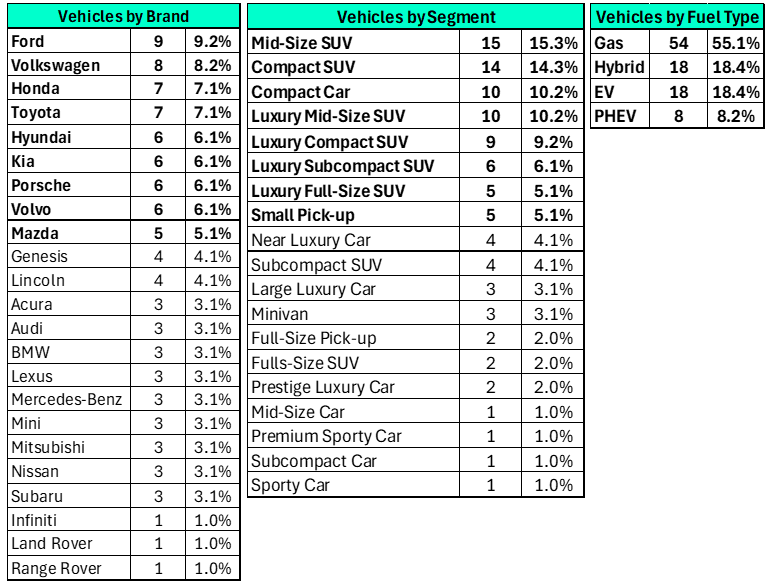
2025 was a year for Mid-Size SUVs as the market examples tested were our largest represented segment, at 15.3% plus 10.2% added from the luxury side. As so many SUVs straddle the lines of size and positioning to be all things to all people, it’s no surprise that we have been testing more of these vehicles now that Compact segment SUV introductions are starting to slow. While we see parts of the market slowing, the rate at which EVs are introduced is not. Announcements of some North American-marketed EVs being offered as Canadian-only models are emerging and we find that better capable and more adequately sized EV utility vehicles built for the average household are arriving to market. Standing at 18.4% of our overall testing, EVs are tied with the share of Hybrids we’ve tested this year. The underlying opportunity though lies within the landscape for Plug-in Hybrids (PHEVs), as they gain market share this year while still under-populated in the general landscape for car shoppers. We understand that plans to change this ratio are underway; therefore, we look to see an upcoming increase over the next couple of years in this market segment, supporting a growing demand for them.
Despite the fact that our top 6 brands tested this year are among mainstream nameplates and make up 44% of tested vehicles, the average as-tested dollar MSRP was a shocking $84,049 as we compare that to the average new car retail listed price typically coming in at only $60,000. We must keep in mind that our test models are typically ‘top of the line’ examples. Our lowest priced vehicle was a mainstream Compact Car, the all-new Kia K4, in a mid-lineup EX trim that came in at $28,695, while the highest priced vehicle was an EV from a luxury brand. The Mercedes-Benz G580e reached an impressive $235,000 while boasting a sub-optimal winter tested EV range of less than 300 km. This reinforces our anticipation that inexpensive mainstream models will continue to build on value and bring greater technology to the masses, while luxury models will push boundaries but struggle to differentiate themselves from the pack in ways they did historically. This will in turn uncover a probable trend of value retention slowly weakening for this sector of the market in comparison to others.
Looking forward to 2026, our valuations team is excited to discover new insights from our evaluation experiences and continue building on them. With our consultative client studies as well as our social media content that is produced to share our experiences and provide insight to the overall industry, we continue to strive for deeper and more influential insights as our car market emerges from some unpredictable times.
Posted in: Dealers