01.27.2026
Market Insights – 1/27/26
Wholesale Prices, Week Ending January 24th, 2026
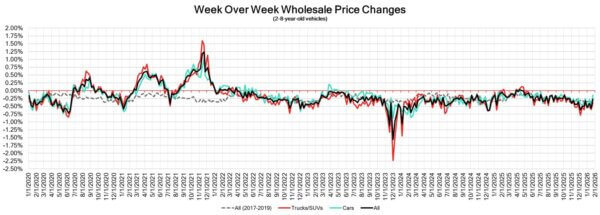
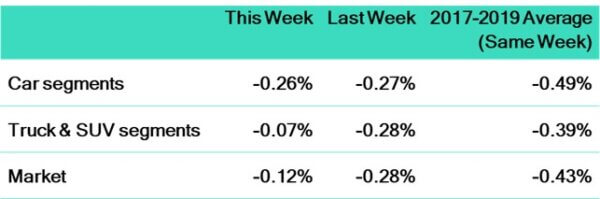
The Canadian used wholesale market saw a decline of -0.28% in pricing for the week. Car segments prices decreased by –0.14% while the Truck/SUV segments decreased by -0.39%. Full-Size Car saw an increase of +0.44%. The largest declines in the Car segments were seen in Mid-Size Car at -0.50% and Compact Car with -0.42%. The largest declines in the Truck/SUV segments were Full-Size Crossover/SUV with -1.33% followed by Compact Van at -1.05%.
| This Week | Last Week | 2017-2019 Average (Same Week) | |
| Car segments | -0.14% | -0.50% | -0.36% |
| Truck & SUV segments | -0.39% | -0.60% | -0.20% |
| Market | -0.28% | -0.55% | -0.28% |
Car Segments
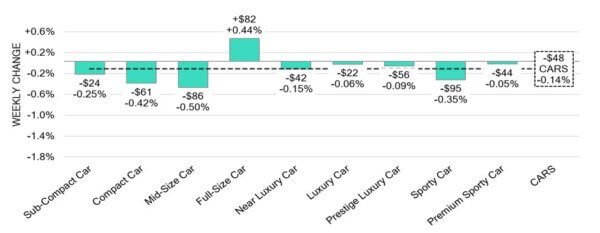
- Last week values softened modestly, with overall car prices down 0.14% as most segments recorded small declines.
- The largest depreciations were seen in Mid-Size Car (-0.50%), Compact Car (-0.42%), and Sporty Car (-0.35%).
- At the other end of the spectrum, Full-Size Car rose (+0.44%) while Premium Sporty Car (-0.05%) and Luxury Car (-0.06%) posted the smallest declines.
Truck / SUV Segments
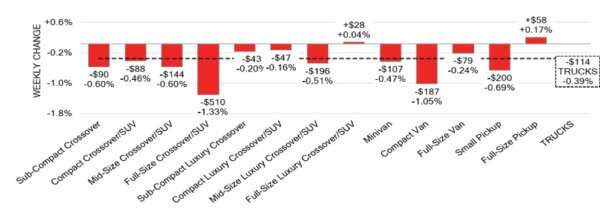
- Last week values softened more noticeably in the truck market, with overall prices down 0.39% as declines were widespread across most segments.
- The largest depreciations were recorded in Full-Size Crossover/SUV (-1.33%), Compact Van (-1.05%), and Small Pickup (-0.69%), with Sub-Compact Crossover and Mid-Size Crossover/SUV (-0.60%) also posting a meaningful drop.
- At the firmer end of the market, Full-Size Pickup rose (+0.17%) and Full-Size Luxury Crossover/SUV edged higher (+0.04%).
Wholesale
The Canadian market remains on a downward path, with a softer decline compared to last week. Car segment values reflected a 0.36% shift resulting in a total decline of –0.14%. Following a 0.21% change this week, truck segment values now sit at a total decline of –0.39%. Less than 28% of market segments saw average value movements greater than ±$100. Monitored auction sale rates this week varied between 33% and 84.4%, averaging at 48.4%. Sales rates across auction lanes have shown ongoing fluctuations, influenced by economic uncertainty, political factors, and sellers supporting firm floor prices. An increase in supply has been noted for the start of the new year; however, upstream channels continue to hold priority sale access to inventory. Buyer demand for high-quality vehicles at auctions on both sides of the border persists.
Used Retail Prices & Listing Volume
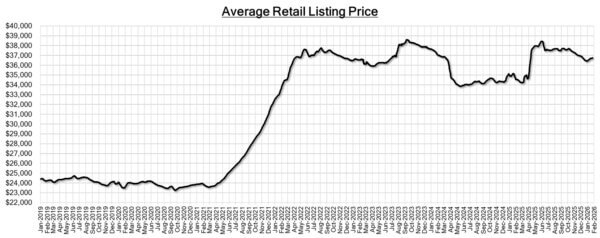
The average listing price for used vehicles is slightly decreasing, as the 14-day moving average was at $36,730. This analysis is based on approximately 204,000 used vehicles listed for sale on Canadian dealer lots.
Market Insights
Economics & Government
- Inflation climbed to 2.4% in December 2025 as the effect of the prior
year GST/HST holiday contributed to higher prices. - Parliament will resume sitting on January 26 with final passage of the fall
budget on the agenda - Canadian Retail Sales increased 1.3% in November with the food and
beverage subset gaining 3%. - The yield on the Canadian 10-year government bond decreased to 3.22%.
- The Canadian dollar is around $0.724 this Monday morning, an increase from
$0.718 a week prior.
U.S. Market
- The market continued to show signs of a potentially early spring last week, with overall declines coming in well below typical levels for this time of year. A handful of segments reported value increases, led by newer inventory, as the 0-to-2-year-old segments were nearly flat overall, declining just -0.01%.
Industry News
- For the 26th year, the Honda Civic has been crowned the best-selling passenger car in the Canadian market. With 31,054 sales, a 2.3% decline from last year, Civic was able to edge out the next best model, the Toyota Corolla by a large margin as the Toyota lost 3.4% sales volume YoY. As consumers turn to crossovers, the compact car segment continues to lose market share overall. The Hyundai Elantra, VW Jetta, and Mazda3 round out the top 5 volume models.
- Toyota has started production of its next-generation Rav4, now selling solely in electrified forms (Hybrid and Plug-in Hybrid). Toyota Motor Manufacturing Canada (TMMC), which operates out of Cambridge, ON, produces 75% of the model’s total volume for North America.
- Chinese carmaker Chery Automobile Co. Ltd. is beginning to form the foundation for selling its EVs in Canada. It looks to become the first Chinese car company to sell its vehicles in the market. Early actions involve recruiting Canadian auto sector professionals, which was a similar activity to Vinfast before it launched its models in Canada.
- Ontario Premier Doug Ford has been outspoken on Chinese EVs in Canada, calling for a boycott of them upon their arrival into Canada. Without a firm decision in their effort to invest in the province or country, Ford says the agreement will harm Ontario’s auto sector.
- European automaker Lotus, now owned by Chinese auto conglomerate, Geely expects a surge in volume of its vehicles to sell into Canada with the downgraded tariffs. The Lotus Electrometric crossover will not support the affordable electric vehicle effort but be one of many Chinese-built EVs looking to access the Canadian market.